Showing posts with label Diane Feinstein. Show all posts
Showing posts with label Diane Feinstein. Show all posts
Thursday, September 19, 2013
Diane Feinstein: The Worst U.S. Senator...
Hands down.
According to Sen. Diane Feinstein (D-CA), the First Amendment is a special privilege and not a right. Feinstein has proposed an amendment to the Media Shield Law that would ignore the protection afforded by the First Amendment and would limit the law's protection only to "real reporters," not bloggers and other upstart alternative media types.
Your rights, chipped away, little by little.


Friday, December 3, 2010
Farewell, Joe Cerrell...

The sun shines a little less bright on the American political landscape right now, especially in Los Angeles. Public policy, publicity, politics and punditry lost a pioneer and a real pro on Friday.
Joseph R. Cerrell, "a legendary political consultant and consummate schmoozer whose unrelenting but principled style won respect from allies and opponents, died of complications related to pneumonia at St. John's Pleasant Valley Hospital in Camarillo, Calif. He was 75."
Cerrell’s roster of clients and friends read like an almanac of U.S., California and Los Angeles politics: "from the 1950s forward — [including] John F. Kennedy, Hubert Humphrey, Al Gore, Dianne Feinstein, Willie Brown, Jesse Unruh and both Pat Brown and his son, Gov.-elect Jerry Brown."
I was fortunate to have interacted a number of occasions with Joe and his colleagues at Cerrell Associates - the vaunted political consulting and public relations firm he founded in 1967. During the times I worked with Cerrell, I was lucky enough to not only hear his stories of great historical/political figures and events, but I also had numerous opportunities to learn from one of the best.
Joseph R. Cerrell, "a legendary political consultant and consummate schmoozer whose unrelenting but principled style won respect from allies and opponents, died of complications related to pneumonia at St. John's Pleasant Valley Hospital in Camarillo, Calif. He was 75."
Cerrell’s roster of clients and friends read like an almanac of U.S., California and Los Angeles politics: "from the 1950s forward — [including] John F. Kennedy, Hubert Humphrey, Al Gore, Dianne Feinstein, Willie Brown, Jesse Unruh and both Pat Brown and his son, Gov.-elect Jerry Brown."
I was fortunate to have interacted a number of occasions with Joe and his colleagues at Cerrell Associates - the vaunted political consulting and public relations firm he founded in 1967. During the times I worked with Cerrell, I was lucky enough to not only hear his stories of great historical/political figures and events, but I also had numerous opportunities to learn from one of the best.
While he was a lifelong Democrat, the man they called "the Dean of LA political consultants," also counted well-known and powerful Republicans among his many friends. He and his firm had a solid reputation for integrity, diligence and smarts. He did politics the way it should be done.
In a LA Daily News obituary for Cerrell, remarks from two prominent California politicians said it all:
- Sen. Dianne Feinstein, D-California, called him a "true California legend. He was the indefatigable wise man of California politics. You could always count on Joe to give it to you straight."
- County Supervisor Zev Yaroslavsky said Cerrell was "a legend and giant in the world of politics and public affairs...Joe gave politics a good name. He loved the game and we has a master of it."
Amen.

Cerrell, with his hands on the car's windshield, was a force behind many major politicians' campaigns. Cerrell served as the youngest-ever chairman of the California Democratic Party. That experience caught the eye of John F. Kennedy’s presidential campaign in 1960, and he became Kennedy’s California campaign manager.
(Photos: Cerrell Associates)
For information regarding the memorial service for Joseph R. Cerrell, go here...
Wednesday, March 24, 2010
What's yours is ours...
More than 300 demonstrators staged a protest march in San Francisco this afternoon, hoping to gain support for their cause: immigration reform.
Organizers said the event was staged in order to take advantage of the large march that occur ed in Washington, D.C., on Sunday, where more than 100,000 protested but were overshadowed by the health insurance reform debate, vote and protests in and around the Capitol.

The crowd gathers around the stage.
The protest started in Justin Herman plaza and later, marchers made their way to the downtown offices of U.S. Sen. Diane Feinstein (D-Money). The march took place during the afternoon rush hour, bringing slowdowns and congestion to an already difficult commute.
While the protest march was disruptive and there was a noticeable police presence, no problems were reported.

According to San Francisco city law, "No protest is complete without a drum circle." (Just kidding.)

Immigration activists/protesters came from cities throughout the Bay Area.
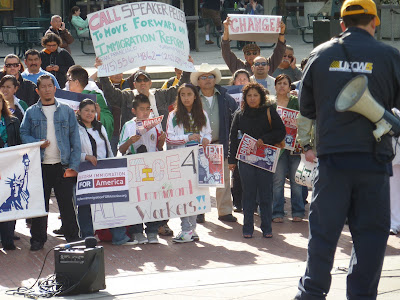
Protesters await their marching orders.

Che's image was plentiful at the protest. (Apparently, the Stalin, Mao and Hitler signs were still on back-order.)

Overseers from the United Commercial Food Workers union were in attendance.

This gentleman helped protesters wrap themselves in the flag.
Organizers said the event was staged in order to take advantage of the large march that occur ed in Washington, D.C., on Sunday, where more than 100,000 protested but were overshadowed by the health insurance reform debate, vote and protests in and around the Capitol.

The crowd gathers around the stage.
The protest started in Justin Herman plaza and later, marchers made their way to the downtown offices of U.S. Sen. Diane Feinstein (D-Money). The march took place during the afternoon rush hour, bringing slowdowns and congestion to an already difficult commute.
While the protest march was disruptive and there was a noticeable police presence, no problems were reported.

According to San Francisco city law, "No protest is complete without a drum circle." (Just kidding.)

Immigration activists/protesters came from cities throughout the Bay Area.

Protesters await their marching orders.

Che's image was plentiful at the protest. (Apparently, the Stalin, Mao and Hitler signs were still on back-order.)

Overseers from the United Commercial Food Workers union were in attendance.

This gentleman helped protesters wrap themselves in the flag.
Sunday, February 21, 2010
"Whiskey is for drinking; water is for fighting over."
When Mark Twain supposedly provided the above quote during California’s early days, settlers already knew then that the future of the West didn’t lie in rich veins of gold or in glittery flakes strewn along the bottoms of mountain streams. No, they understood – as so many others have come to – that no business, community or state is possible without H20. And in California, where agriculture is the No. 1 business in an economy that is the eighth-largest in the world, water is everything.

Prescient...
A town founded as a Spanish pueblo in the near the Southern California coast back in the late 1700s – the City of Angels (aka: Los Angeles) – was experiencing explosive growth at the beginning of the 20th century. The city fathers, The Powers-That-Be, Hollywood, the Los Angeles Times and others knew that if LA was to grow and thrive, it – like the crops of The Nation’s Salad Bowl (aka: the San Joaquin Valley) – would need Mother Nature’s precious elixir.
So in a story we all know, thanks to a little film starring Jack Nicholson, Faye Dunaway and John Huston back in 1974 (directed by Roman Polanski), LA – with the help of all sorts of politicians, moneymen and ne'er-do-wells – raped California’s lesser-known Owens Valley. William Mulholland (played by Huston in the film), then-superintendent of the Los Angeles Department of Water and Power created the 223 mile-long Los Angeles Aqueduct (completed in 1913) to divert water from the Owens River. As one source notes, “Much of the water rights were acquired through subterfuge, with purchases splitting water cooperatives and pitting neighbors against each other. The purchases led to anger among local farmers, which erupted in violence in 1924, when parts of the water system were sabotaged by local farmers.”

William Mulholland - the godfather of LA water...
The rape of the Owens Valley (which LA repeated in the early 1970s), not only left a well-irrigated, fertile agriculture area a shadow of its former self, but it helped set the stage for decades of California water wars to come.

The Owens Valley and its neighbor, the San Joaquin Valley - it's all about money, water and food...


Prescient...
A town founded as a Spanish pueblo in the near the Southern California coast back in the late 1700s – the City of Angels (aka: Los Angeles) – was experiencing explosive growth at the beginning of the 20th century. The city fathers, The Powers-That-Be, Hollywood, the Los Angeles Times and others knew that if LA was to grow and thrive, it – like the crops of The Nation’s Salad Bowl (aka: the San Joaquin Valley) – would need Mother Nature’s precious elixir.
So in a story we all know, thanks to a little film starring Jack Nicholson, Faye Dunaway and John Huston back in 1974 (directed by Roman Polanski), LA – with the help of all sorts of politicians, moneymen and ne'er-do-wells – raped California’s lesser-known Owens Valley. William Mulholland (played by Huston in the film), then-superintendent of the Los Angeles Department of Water and Power created the 223 mile-long Los Angeles Aqueduct (completed in 1913) to divert water from the Owens River. As one source notes, “Much of the water rights were acquired through subterfuge, with purchases splitting water cooperatives and pitting neighbors against each other. The purchases led to anger among local farmers, which erupted in violence in 1924, when parts of the water system were sabotaged by local farmers.”

William Mulholland - the godfather of LA water...
The rape of the Owens Valley (which LA repeated in the early 1970s), not only left a well-irrigated, fertile agriculture area a shadow of its former self, but it helped set the stage for decades of California water wars to come.

The Owens Valley and its neighbor, the San Joaquin Valley - it's all about money, water and food...
Today, in the northern part of the state, the failing levee system – which protects the San Joaquin Valley from the intrusion of the Sacramento-San Joaquin River Delta’s salt waters – has been declared the nation's most endangered waterway system by the environmental group due to water shortages caused by the Delta's environmental challenges, declining fish populations and aging levees, among other problems. Meanwhile, the farmers of the Central Valley, because of federal Endangered Species regulations, are getting 10 percent or less of the amount of water due them – which, when combined with the failing economy (California’s unemployment rate hovers near 10 percent, but farm communities in the San Joaquin Valley are experiencing jobless rates of 20, 30, 40 percent – and more).
In addition, Southern California – which has grown far beyond anyone’s imagination – is always in a water deficit. Unable to keep itself watered, it constantly draws on any source it can…often drawing the rest of the state’s ire.
Case in point (from the Contra Costa Times): “Invoking the specter of a century-old Los Angeles water grab, Northern California farmers have filed a lawsuit that may escalate the state's ongoing water crisis. The farmers say the San Joaquin Valley communities hardest hit by drought and new protections for endangered species in the Delta — including the nation's largest irrigation district — are nevertheless illegally getting water that belongs to the northerners. ‘The last thing we want to see is the Sacramento Valley become another Owens Valley,’ said Tehama-Colusa Canal Authority general manager Jeff Sutton. He was referring to the early 20th century raid on the Owens Valley by Los Angeles, an episode made famous by the 1974 movie ‘Chinatown.’"
Against the backdrop of this latest salvo, Californians also are considering an $11billion-plus ballot proposition (which contains more than $2 billion in earmarks) in June that is championed by Gov. Arnold Schwarzenegger but opposed by more than 55 percent of voters surveyed (not to mention key environmental groups). According to a piece in the San Francisco Chronicle, “The $11 billion bond to overhaul California's water system that will go before voters in November is in big trouble, according to a poll released Thursday. The survey, paid for by opponents of the bond measure and conducted by veteran San Francisco pollster Ben Tulchin, found that 55 percent of registered voters sampled would vote against the bond if the election were held today, while 34 percent said they would vote in favor. Tulchin said support for the bond is ‘beyond low.’"
In addition (according to a report in the Sacramento Bee), “U.S. Sen. Dianne Feinstein has proposed legislation to make it easier to transfer water to San Joaquin Valley farmers from other areas of the state, part of her ongoing effort to help farmers contending with water shortages. Feinstein made headlines last week with a controversial proposal to amend a federal jobs bill to guarantee San Joaquin Valley farmers 40 percent of their contract water deliveries from the federal government. Her 'Water Transfer Facilitation Act' has received far less attention. It was approved by a Senate committee in December and awaits a floor vote. The bill aims to streamline regulations surrounding water transfers among Central Valley farmers and water districts, who generally get their water in one of two ways: Some have actual rights to a specified allotment from rivers; others buy water under contract with the federal government. In a given year, those who contract for water get only as much as the government thinks it can provide based on drought conditions and environmental need. Such is the case for many farmers in the San Joaquin Valley, who last year got just 10 percent of their contracted amount. The system also allows for users with water rights to sell a portion of their water to another user. Feinstein has said her bill would allow an additional 300,000 acre-feet of water transfers among Central Valley users. One way it would do so is by waiving individual environmental reviews to protect the Sacramento Valley's threatened giant garter snake. Instead, a blanket review would cover all the transfers.”
What the Feinstein amendment doesn’t tell you, however, is that if it were passed it will directly benefit one of her biggest supporters – “Stewart Resnick, a Beverly Hills billionaire and one of the largest landowners in the southern Central Valley who controls the Kern Water Bank. Resnick is a political contributor to Sen. Feinstein, and if her amendment passes, he will receive more Delta water to sell at a profit to southern California developers” (according to the Fresno Bee – the paper of record in the San Joaquin Valley).

DiFi...
Some things never change.

Subscribe to:
Posts (Atom)


